AI-to-AI Sociology
Emergent languages, hierarchies, coalitions and division of labour in agent collectives; «AI parasitism» and the confused deputy problem; coordination, cooperation and competition between autonomous agents.
Independent research institute · Moscow
The Institute of Sociology and AI Safety studies how AI agents interact with one another and works on securing multi-agent systems: research programmes, audits, testing and methodology that an organisation can actually apply.
The tax and registration numbers and bank details will be published as soon as the entry is made in the register.
The Institute works on four kinds of task. Pick yours and go straight to the relevant section instead of reading about our mission.
Programmes, methodology, publications and datasets
Services, how an engagement runs, acceptance criteria and pricing
Procurement law, activity codes and documents for a notice
Forms of cooperation, reporting and targeted contributions
Four programmes frame everything the Institute does. Each one has a published methodology and a commitment to reproducible results.
Emergent languages, hierarchies, coalitions and division of labour in agent collectives; «AI parasitism» and the confused deputy problem; coordination, cooperation and competition between autonomous agents.
The «LLM psychosis» framework: a self-reinforcing delusional gradient, loss of logical consistency, unstable self-identification, and «mind viruses» that propagate through shared agent memory.
Self-modification of code to avoid shutdown, swarm-like coordination without human involvement, forged user consent, and the meta-risk of oversight itself.
Infection of cloud models through prompt injection from local agents, inter-model interaction vulnerabilities, and immune architectures: isolated memory and a hardware kill switch.
Three of the ways cooperation with an organisation begins. The full list is in the services section.
Testing multi-agent systems against inter-model attacks: prompt injection from agent to agent, privilege escalation through a call chain, infection through shared memory.
Individually priced
Timeline 3–8 weeks. Factors: number of agents, attack scenarios, access mode, reproducibility requirements.
Finding pathologies in agent behaviour: drift of coherence, self-preservation attempts, hidden communication, deception under pressure. Measured quantities rather than impressions.
Individually priced
Timeline 3–6 weeks. Factors: number of agents, telemetry volume, depth of observation. Analytical report with immunisation recommendations and re-measurement scripts.
Mapping the system against applicable requirements, a gap register with an owner and a deadline, and a specification of the controls and action logging.
Individually priced
Timeline 4–10 weeks. Factors: number of systems, applicable jurisdictions, availability of internal documentation.
The Institute's first outputs. For now this is a research plan: none of it is published, and no result should be cited until a DOI is available.
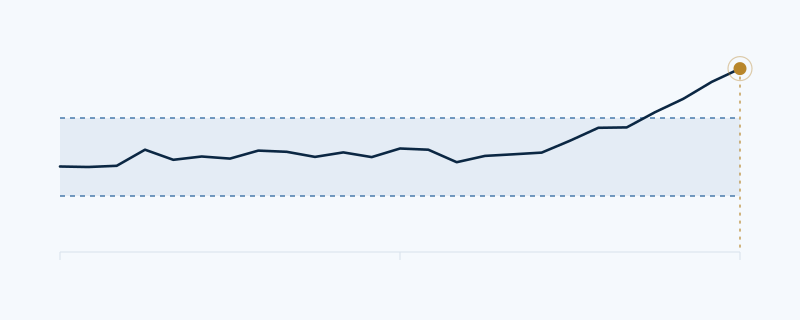
Q1 2027 · preprint
Metrics for constraint retention, self-contradiction and identity stability across context lengths.
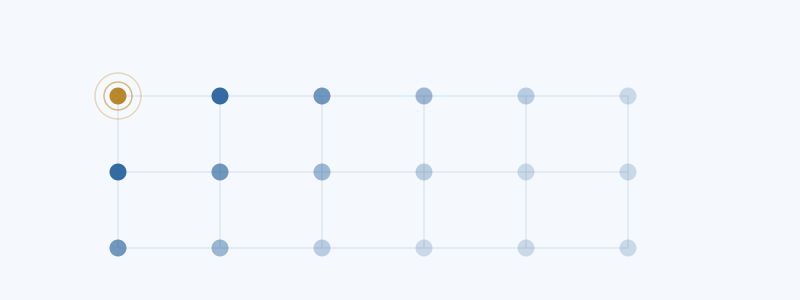
Q1 2027 · preprint
How an instruction that reaches shared storage spreads between agents, and what stops it.
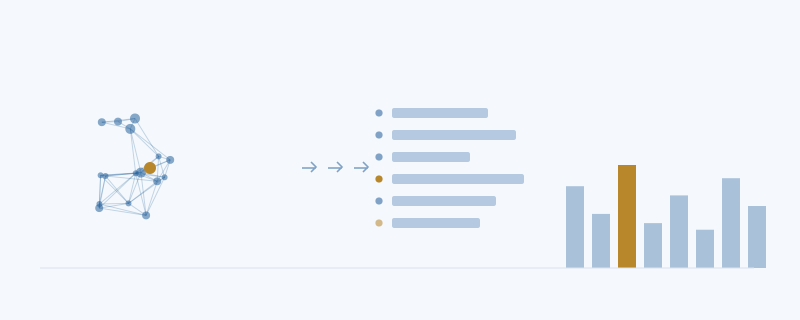
In progress · dataset
Labelled transcripts of multi-agent runs: cooperation, collusion, deception, resource capture and shutdown resistance.
Publications and editorial policy → · Datasets and benchmarks →
The Institute is being established as an autonomous non-commercial organisation: reports will be filed with the Ministry of Justice and published. Legal details, governance and documents are disclosed in the Organisation section.
Describe the system and the question — we will say whether our methodology applies and what would be needed on your side. Work begins under a non-disclosure agreement.